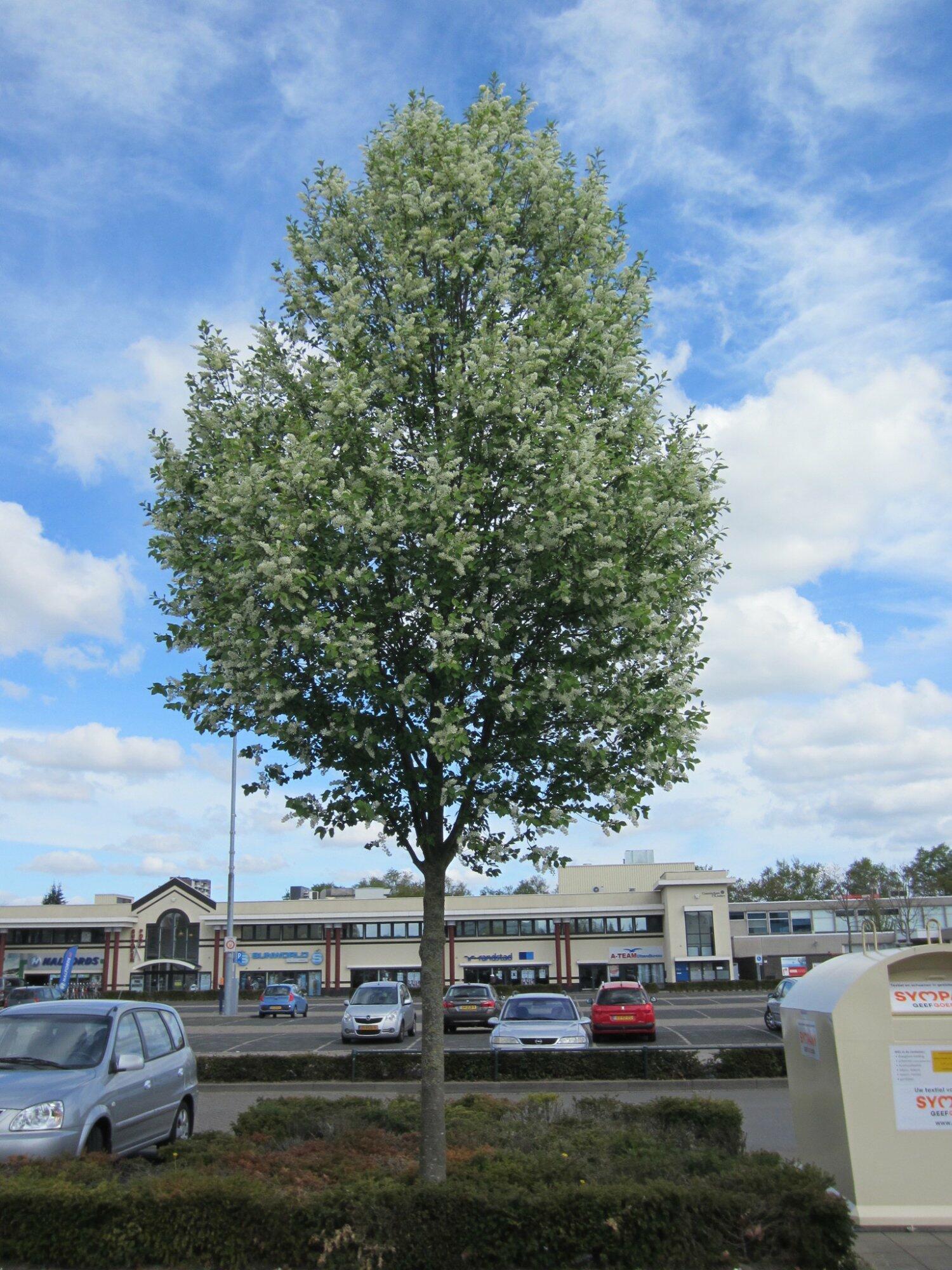
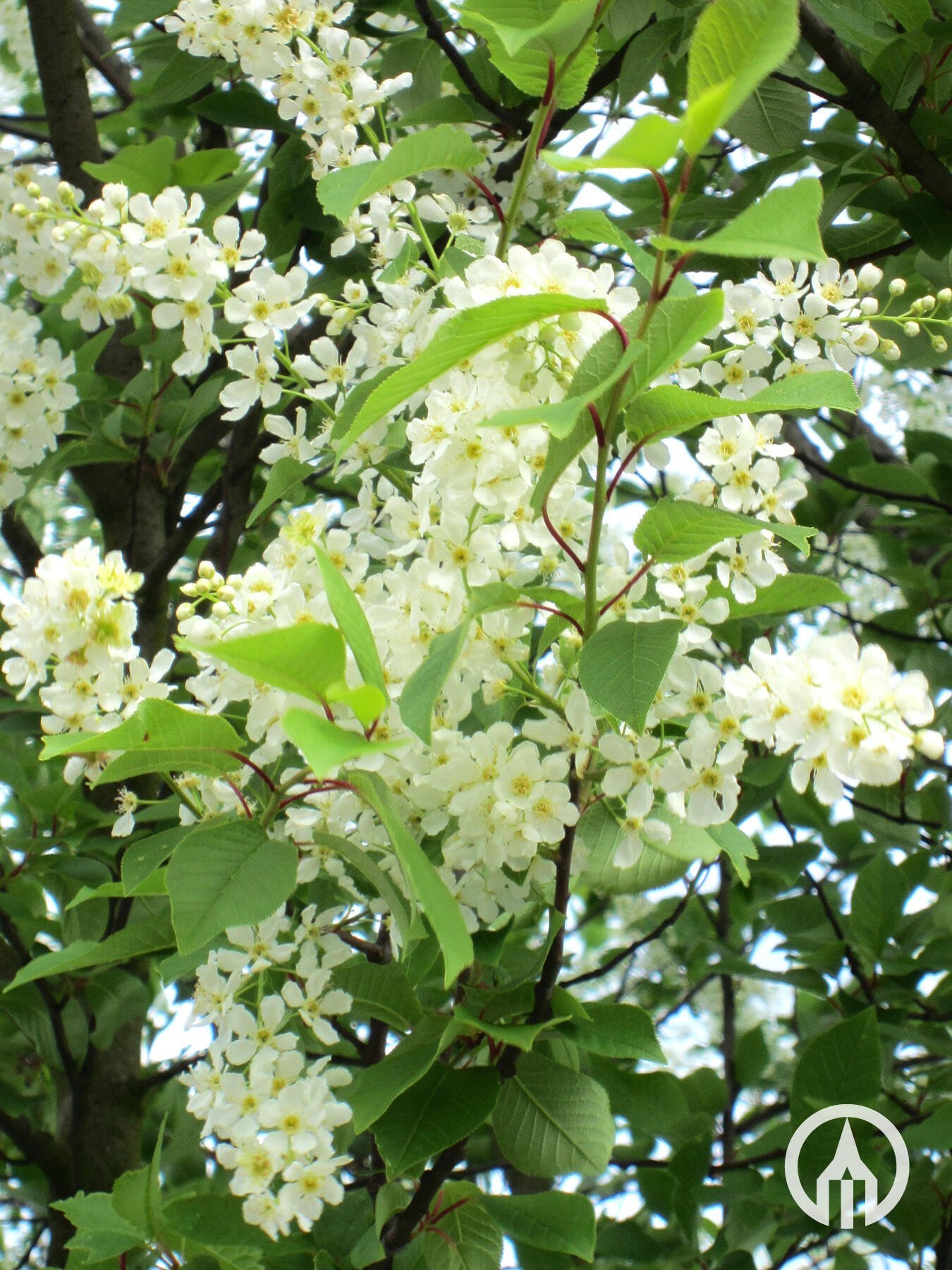
Below, we describe Prunus padus, the common bird cherry. The tree can eventually grow to a height of 8 to 12 meters and has a dense, ovoid crown. These specific characteristics make the tree suitable for use as a landscape plant in parks and along green belts.
The inflorescence is very ornamental, with large clusters of white flowers in April; it appears as the leaves emerge on the tree. The inflorescence, combined with the green leaves, is often quite beautiful. Afterward, dark blue berries—or drupes—develop, which are very popular with birds; however, they are not edible for humans. The tree owes its Dutch name, ‘vogelkers’ (bird cherry), to this characteristic.
The leaves are light green; unlike those of the American bird cherry, they are not glossy or leathery. The shape is elliptical to oblong, and the leaf margin is serrated. There are two nectar glands on the petiole; ants, beetles, and bees are attracted to them.
The range of the common bird cherry covers a large part of Europe; notably, as one travels further south, the species becomes increasingly confined to mountainous areas. The species is also found in the neighboring regions of Western and Central Asia.
Location of photos: Eindhoven